Greece's golden visa is now zone-priced. The minimum is €800,000 (around $865,000) in prime areas, €400,000 (around $430,000) elsewhere, and €250,000 (around $270,000) for commercial-to-residential conversions or listed-building restoration. Both standard tiers require a single property of at least 120 m². Residency runs five years, renewable, with no minimum stay, and citizenship is possible after seven years.
How is the Greece golden visa priced in 2026?
Greece replaced its flat €500,000 property route with a tiered, location-based structure under Law 5100/2024, with the higher thresholds in force since September 2024 (Enterprise Greece; Law 5100/2024). The qualifying purchase now starts at €800,000 in high-demand zones, €400,000 across the rest of the country, and €250,000 for two narrow conversion categories.
The €250,000 entry point that built the program's reputation no longer applies to standard residential purchases. For most buyers the real choice is between the €400,000 regional tier and the €800,000 prime tier, and that choice is geographic before it is financial. Where you want to own decides what you pay, the entry-price gap between the two tiers is roughly 2×, and it reflects demand pressure on prime addresses rather than any difference in what the visa delivers.
Which areas fall into the €800,000 tier?
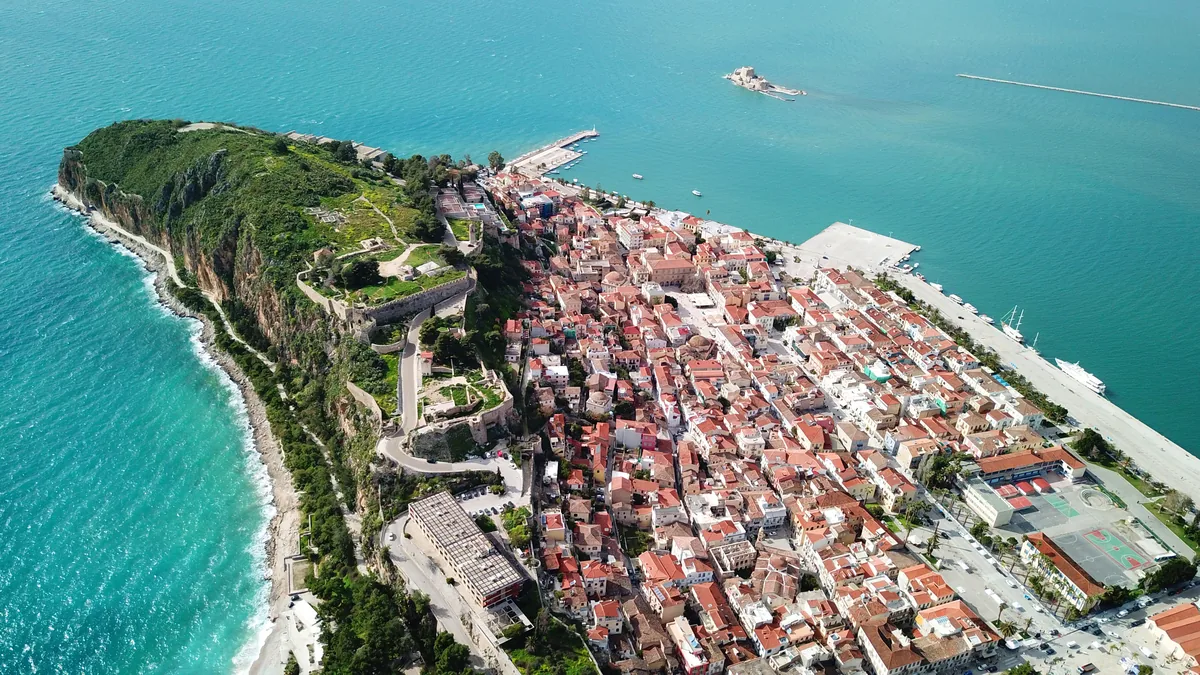
The €800,000 band covers the entire region of Attica, which includes Athens and Piraeus, the municipality of Thessaloniki, Mykonos, Santorini, and any Greek island with more than 3,100 residents (Enterprise Greece). Everything outside that list sits in the €400,000 band.

In practice the €400,000 tier holds the Peloponnese, Halkidiki, western Greece, mainland regions away from the two big cities, and the smaller islands below the 3,100-resident line. The structure pushes capital toward less dense areas by design. A buyer set on a central Athens address or a Cycladic name like Mykonos or Santorini is in the €800,000 tier by definition, while the same budget on the Peloponnese coast or a quieter island buys at the lower threshold with room to spare.
When does the €250,000 tier still apply?
In two cases only. A commercial property converted to residential use, and the restoration of a listed or protected building, each available anywhere in Greece (Enterprise Greece; Law 5100/2024). The conversion or restoration must be completed before the application is filed, and the 120 m² minimum does not apply to this tier.
This is the part most summaries flatten. The €250,000 figure is real, but it is a renovation route, not a turnkey one. The buyer carries execution risk, the conversion has to be finished and properly documented before the file goes in, and the qualifying asset is a project rather than a finished home. It suits a buyer comfortable managing a build in Greece, not one who wants to wire funds and hold a deed.
What does the 120 m² minimum rule out?
Both standard tiers require a single property of at least 120 m² of living area, with no combining of smaller titles to reach the threshold (Watson Farley & Williams, on Law 5100/2024). That rules out the pre-2024 tactic of splitting capital across two compact apartments. One qualifying asset, one title, 120 m² floor.
One restriction worth flagging for buyers modeling yield: short-term letting is prohibited on golden-visa property (Enterprise Greece). The home can be let on long-term contracts, but listing it on Airbnb or Booking.com carries a €50,000 fine per property and revocation of the permit (per Article 92 of the Migration Code). A buyer counting on nightly-rental income to carry the asset should price that out before committing.
Do you have to live in Greece, and who can you include?
No minimum stay is required to hold or renew the permit, you can keep the residency without relocating (Enterprise Greece). Physical presence only becomes load-bearing if you pursue citizenship later. One application covers the spouse or registered partner, children under 21, extendable to 24 for full-time students, and the parents and parents-in-law of both spouses.
That family scope is one of Greece's quieter advantages. A single qualifying purchase can place three generations on residence permits, with the children's window stretched while they study. The permit grants Schengen travel and the right to live in Greece, without obliging the family to move there, which is why much of the demand is mobility and optionality rather than relocation.
How long until citizenship, and how does the process run?
Citizenship is possible after seven years of continuous legal residence, but only with real presence, 183 days a year in Greece plus language, history, and culture tests (Greek Citizenship Code, Law 3284/2004 as amended). The residence card itself targets four to six months from application, though some files run six to nine, and the only step needing personal attendance is the biometrics appointment, schedulable within twelve months of filing.
The process runs in a defined order: select and reserve the qualifying property, obtain a Greek tax number and bank account, complete the purchase before a notary, file the residence application with proof of the investment, attend biometrics, and collect the card. The permit then renews every five years for as long as the qualifying property is held. Sell the asset, and the basis for the residency falls away. For how Greece compares across programs on these timelines, see our 2026 Golden Visa overview.
Which tier actually suits which buyer?
The tier is set by where you want to own, not by how much you want to spend. A prime-city or marquee-island buyer is in the €800,000 band, a value-and-yield buyer has the whole €400,000 country to work with, and a renovation-minded buyer can reach €250,000 by taking on a conversion or a listed-building project.
| Tier | Where it applies | Min. living area | Who it suits |
|---|---|---|---|
| €800,000 (~$865,000) | Attica (Athens, Piraeus), Thessaloniki municipality, Mykonos, Santorini, islands above 3,100 residents | 120 m², single property | Buyers committed to a prime address or marquee island, where demand, not the visa, sets the floor |
| €400,000 (~$430,000) | All other regions: Peloponnese, Halkidiki, western Greece, mainland, smaller islands | 120 m², single property | Buyers who want the lowest standard entry and treat residency as the primary goal |
| €250,000 (~$270,000) | Commercial-to-residential conversions and listed-building restoration, anywhere | None for this tier | Buyers comfortable managing a build, completed and documented before filing |
Thresholds in this program have moved more than once since 2023, so treat the table as a map, not a quote, and reconfirm the current figures with licensed counsel before any commitment.
The bottom line
Greece is one of the few European routes where the property itself is the qualifying asset rather than a fund subscription, and the price you pay turns almost entirely on geography. Decide the address first. If it sits in Attica, Thessaloniki, or on a marquee island, the entry is €800,000, if it sits anywhere else, €400,000, and the €250,000 route is open only to those willing to run a conversion or restoration to completion before they apply.
For buyers weighing a property-led route specifically, the active 2026 comparison is between Greece's regional and prime tiers and the UAE's 10-year property route, the other major route where real estate is the qualifying asset rather than a fund or a fee. For a faster Gulf alternative at a lower entry point, see Qatar's 2026 property route. For the wider field, see how Greece compares across programs on thresholds, citizenship, and timelines.
The Brightwill view
We read a golden-visa purchase the way we read any asset, by the property before the permit. A threshold tells you the entry point, it does not tell you whether the address holds value, whether the developer delivers, or whether the residency survives the next rule change. In Greece specifically, the €250,000 conversion route and the short-term-rental ban are where buyers most often misjudge what they are actually taking on.
Brightwill Luxury is a curated access platform, not a brokerage, law firm, or financial adviser. The Greek projects we surface are selected so the real estate stands on its own, with the qualifying threshold treated as a floor rather than a target, and we work with counsel who represent you, not the seller. Rules here change, verify every threshold and timeline before any money moves.
Tell us your target island or region, and we will say which Greek tier, €400,000 or €800,000, it falls in →