Most branded residences borrow a name. A hotel group lends its service standards, a fashion house lends its palette, and the building wears the logo at the gate. Tierra Viva, the first Automobili Lamborghini residential project in Europe, attempts something harder. It borrows a design philosophy - one developed over six decades to make metal look fast standing still - and asks whether it can be poured into concrete, glass and marble on a hillside above the Mediterranean.
The result, developed by London-listed DarGlobal in the hills of Benahavís, is the first and only Lamborghini-inspired gated community on the continent and the first branded residences in Spain. But the interesting question is not how exclusive it is. It is whether a supercar's design language actually survives the translation into a house - and what that translation teaches us about the fast-growing world of branded living.
At Brightwill, our view is simple: design-led branded residences live or die on whether the brand's language is genuinely translated, not merely referenced. Tierra Viva is a useful place to test that idea, because Lamborghini's design language is unusually specific and, once you know it, easy to read.
The Lamborghini design alphabet
Before you can see Lamborghini in a building, it helps to know what makes a Lamborghini look like a Lamborghini. The brand, founded in 1963 in Sant'Agata Bolognese, has spent its history refining a small, recognisable vocabulary of shapes. Four ideas do most of the work.
The hexagon
The six-sided shape is Lamborghini's signature motif. It first appeared in the 1960s - on the rear of the Miura and the dashboard of the Marzal concept - in an era intoxicated by space travel and moon missions. The hexagon reads as high-tech and efficient; it is, after all, the shape nature chooses for the honeycomb because it is strong and wastes nothing. Today it turns up everywhere on the cars, from grilles and exhaust tips to the stitching on the seats.
The Y
Cut a hexagon in half and you get a Y. That fork is the second pillar of the brand's identity, most visible in the headlights and tail lights of modern models like the Revuelto. Lamborghini's designers openly borrow from aviation here - the Y and the arrowhead echo the lines of an F-35 fighter jet - which is why the cars can look like aircraft that took a wrong turn onto a road.
The wedge, and the single line
In the 1970s the designer Marcello Gandini turned the soft curves of the Miura into the brutal wedge of the Countach, and Lamborghini's silhouette has been sharp ever since. The so-called Gandini line runs in one continuous stroke from the nose to the tail, giving the car a sense of forward motion even when it is parked. It is the single most useful idea to carry into architecture: how do you make something stationary look like it is moving?
Aerodynamics as a belief system
Finally, the cars are shaped by function. Lamborghini designers talk about aerodynamics as a religion and describe their goal as a jet fighter on four wheels: a low, compact, dramatic stance in which every crease channels air, cools an engine or presses the car to the road. Nothing is decoration for its own sake. That discipline - beauty justified by purpose - is the hardest part of the brand to fake.

From a moving object to a fixed one
Here is the genuine design problem at the heart of Tierra Viva. A car is meant to be seen in motion, from the outside, at speed. A house is the opposite: still, lived in from the inside, experienced slowly over years. Translating one into the other is not a matter of stamping hexagons on the façade. It means finding architectural equivalents for the feelings the cars produce.
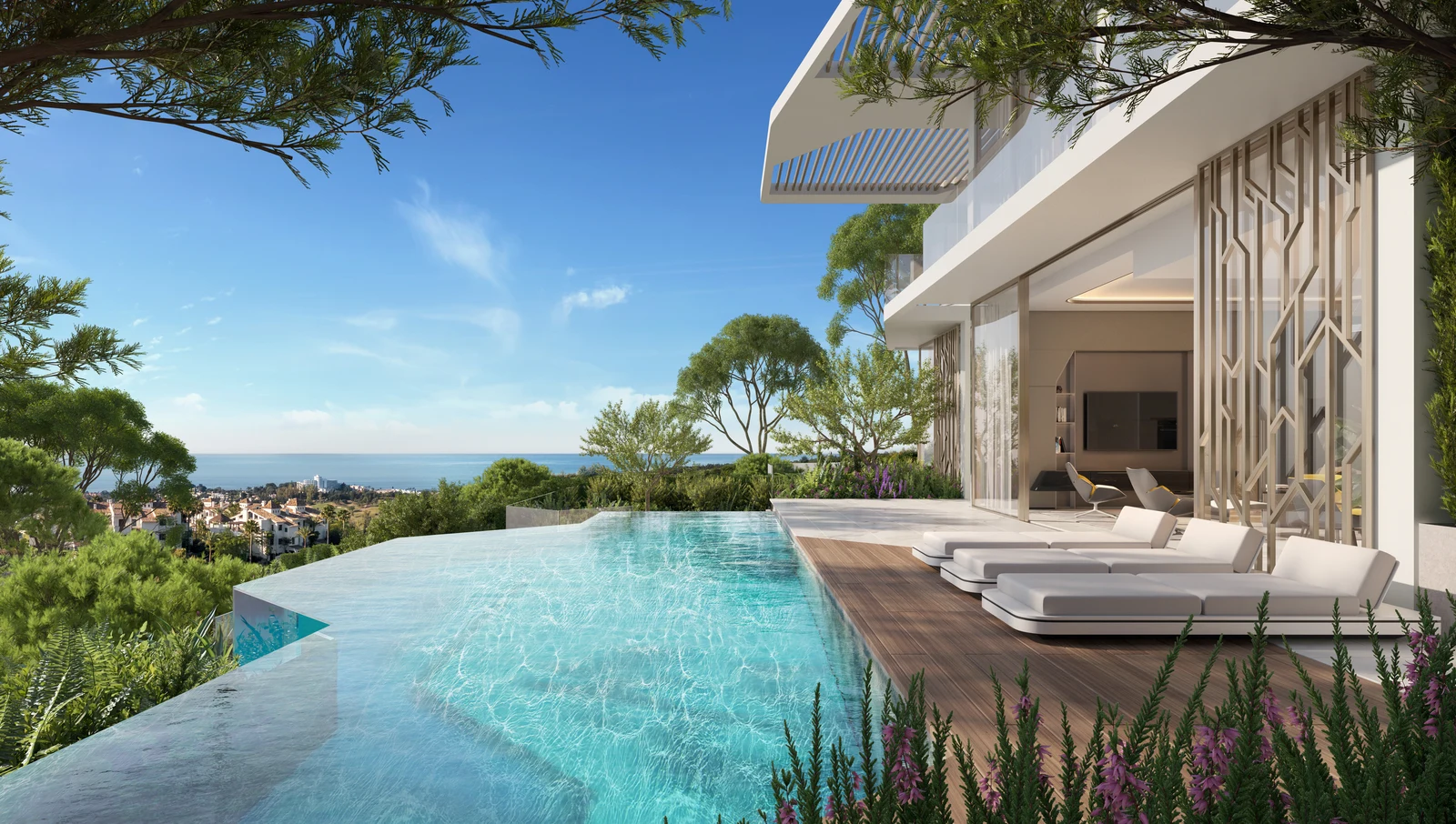
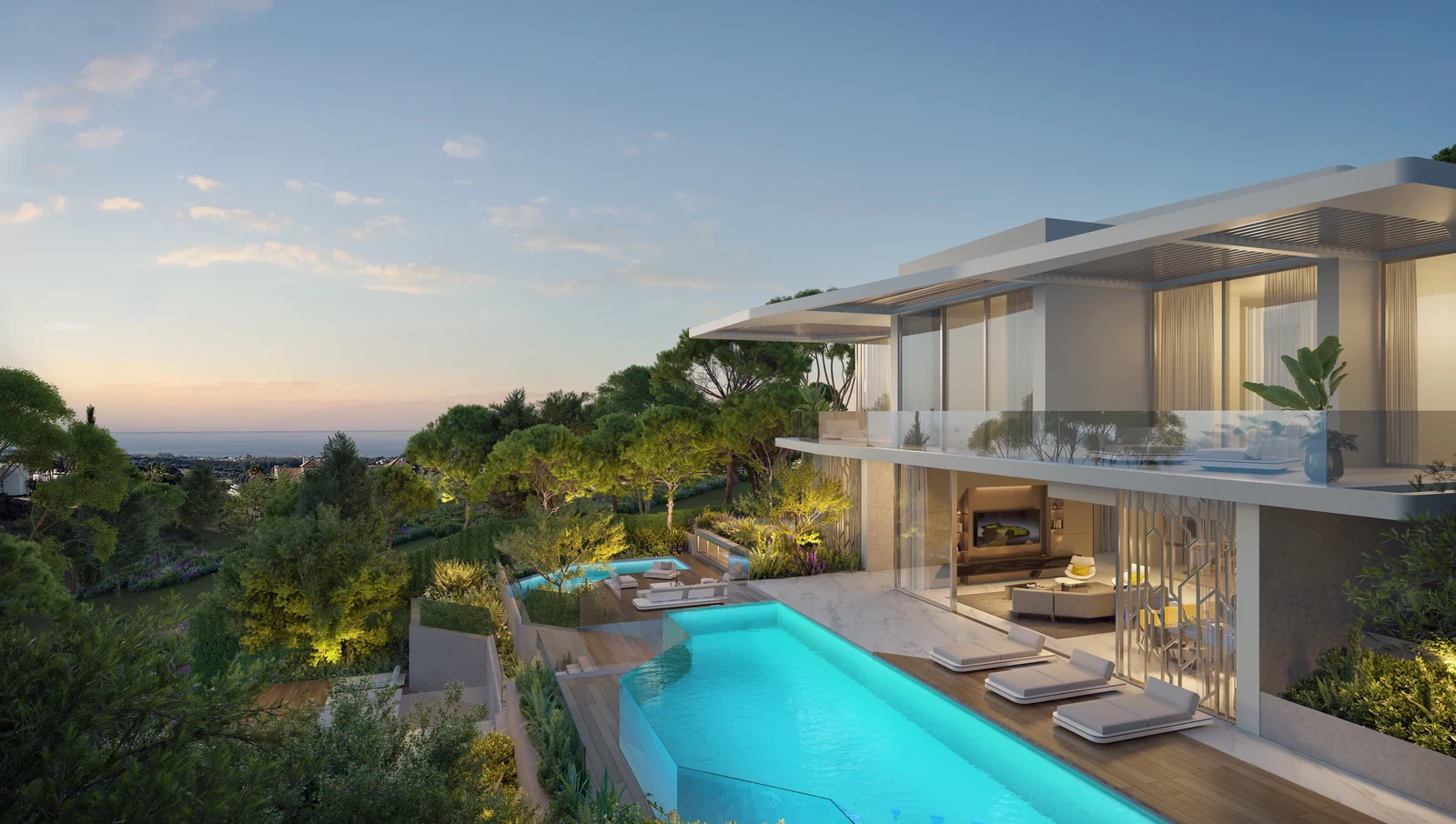
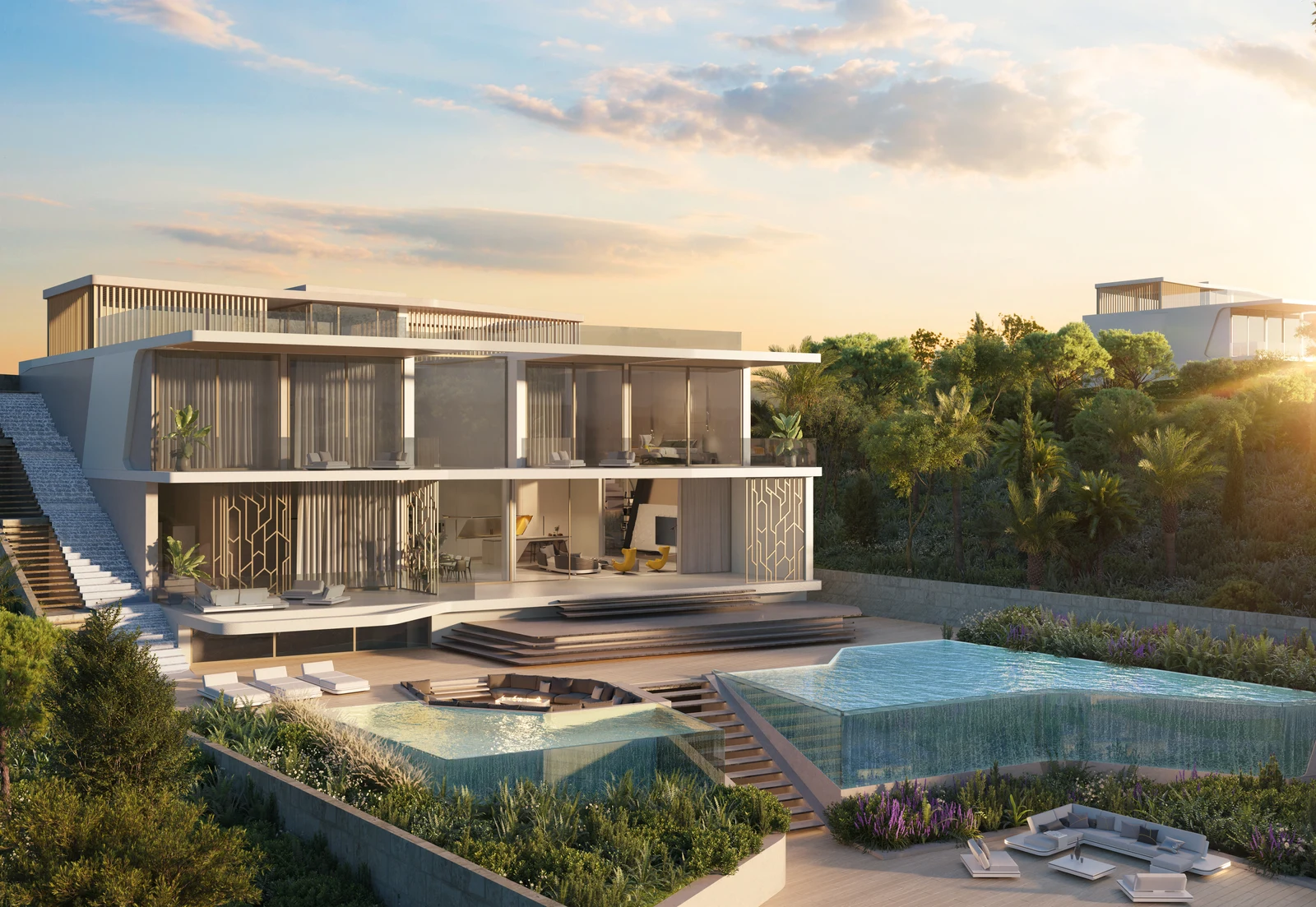
At Tierra Viva that translation shows up as sharp, angular geometry and long unbroken lines that pull the eye across each villa the way the Gandini line pulls it along a Countach. The mansions sit low and wide on their plots, stepping down the hillside across two to four levels, so that the architecture has the planted, forward-leaning stance of a car in its lowest gear. Glass is used the way it is in a cockpit - to dissolve the boundary between the interior and the view beyond. The brand summarises its own intent in three words stamped through the project: sharp lines, pure intent.
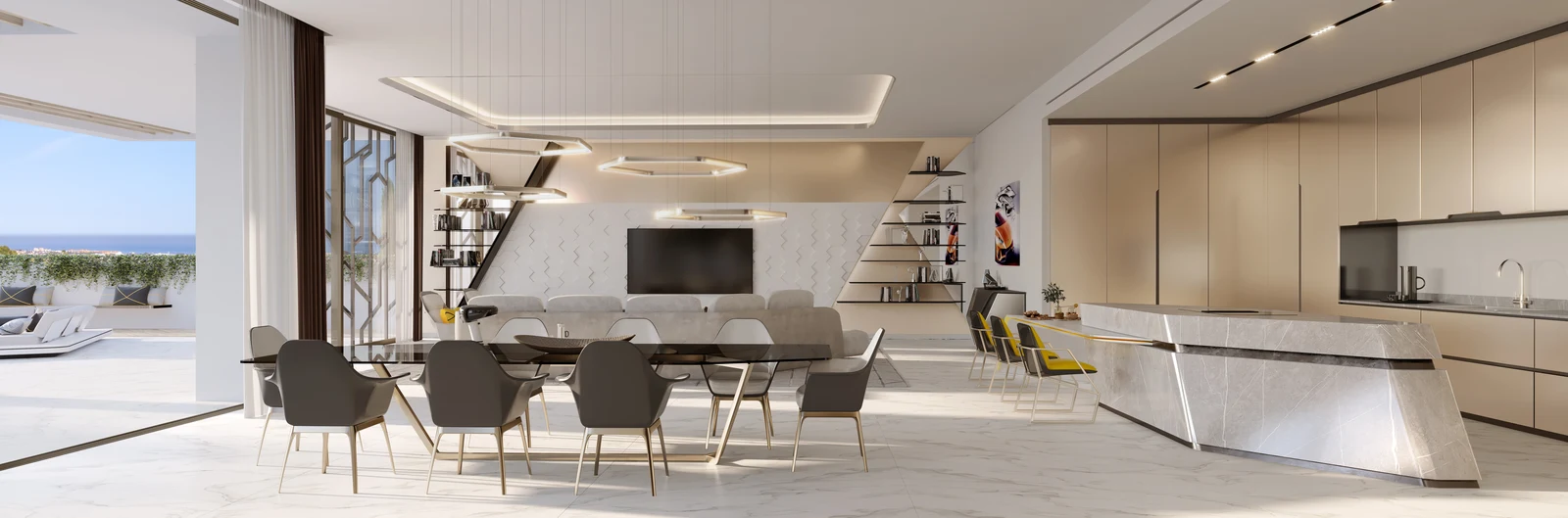
Inside, the supercar references become tactile rather than literal. The material palette - marble and porcelain floors, fine leather, engineered stone, lacquered joinery and glass - mirrors the contrast of hard and soft surfaces in a Lamborghini cabin, where carbon and metal meet hand-stitched hide. Specifications run to Cosentino and Inalco surfaces, Miele kitchens and Duravit and Villeroy and Boch bathrooms, with an aerothermal system heating and cooling the house quietly in the background. The effect is meant to feel engineered, not merely decorated - the same logic that governs the cars.

The car as the centerpiece
The clearest expression of the whole concept is also the most theatrical. Selected villas include a private car lift that carries the owner's Lamborghini up into the home and parks it inside a glazed enclosure, visible from the living space. The community clubhouse extends the idea with a dedicated showroom, framed by the line the brochure uses without irony: some people collect art, others collect machines.
It would be easy to dismiss this as a gimmick. It is more interesting read as a cultural signal. For a certain kind of owner, the car is not transport to be hidden in a basement; it is an object of design worth displaying, the way a collector builds a room around a painting or a watch. Tierra Viva simply takes that instinct to its logical conclusion and makes the garage the gallery. Whether or not you would live this way, it tells you precisely who the house is for.
Inside the gates
Beyond the design story, Tierra Viva is a gated community of a limited collection of villas, each set at a different elevation so that the homes look out over the coastline rather than at one another. The architecture comes in four signature designs named after precious stones - the four-bedroom Esmeralda, the five-bedroom Zafiro and Painite, and the six-bedroom Diamante - ranging from two to four levels. Privacy is built into the topography: the hillside does much of the screening that walls would otherwise have to.
The shared amenities lean into the motoring theme without tipping into parody. The clubhouse gathers a gym, an owner's lounge, the Velocity Bar and Lounge and what the developer bills as the world's first Lamborghini Café, while the spa runs to sauna, hammam, steam and jacuzzis - framed, inevitably, as the service every high-performance machine needs. Adult and children's pools and a play area position the community for families as much as for single-minded collectors.
Location is the quiet luxury underneath the branding. Benahavís sits in the hills behind Marbella, and the project puts the Mediterranean shore about five minutes away, Puerto Banús around twelve, the Marbella Club and Golden Mile roughly sixteen, and Málaga's international airport about forty-five. Completion is anticipated in 2028. For buyers weighing the practicalities of committing before completion, our off-plan buying guide covers the due diligence that matters.

Why a supercar maker builds houses
Tierra Viva is part of a broader pattern. Automotive names - Lamborghini, Bugatti, Aston Martin, Bentley, Porsche, Mercedes - have followed hotels and fashion houses into real estate, and they are doing it for a reason beyond licensing income. A residence extends a relationship that used to end at the dealership into something permanent. It turns a brand a person drives into a brand they live inside.
This is also where buyers need to be literate, because not all branded residences are the same thing. Some are operationally branded, run day to day by a hotel operator who delivers the service. Others, like Tierra Viva, are design-led: the brand shapes the architecture, the interiors and the atmosphere, but does not check you in at a front desk. Neither model is better in the abstract; they simply promise different things. We unpack how the category works, and why it tends to command a premium, in our explainer on why branded residences are reshaping luxury real estate.
Costa del Sol's branded-residence moment
For years the densest branded-residence markets were Dubai and Miami. The Costa del Sol is now emerging as the next frontier, and Tierra Viva - as the first branded residences in Spain - is a marker of that shift. It is not alone: the coast has also drawn fashion-led projects such as Marea, with interiors by Missoni, a short drive west in Casares. Where Dubai offers density and Miami offers liquidity, the Costa del Sol offers something the cars themselves trade on: landscape, light and a sense of arrival.
The Brightwill view
Strip away the showroom theatre and Tierra Viva is a real test of a real idea. The branded-residence market is full of projects where the logo is the loudest thing in the room. The ones worth owning are those where the brand's actual design language - its proportions, its materials, its discipline - is carried all the way through, from the silhouette on the hill to the stitching on a built-in sofa. On that measure, a Lamborghini house is a more demanding brief than most, precisely because the design language is so specific and so widely known.
For the right buyer - someone for whom the car in the glass box is the point, not the punchline - that specificity is the appeal. For everyone else, Tierra Viva is still worth understanding, because it shows where branded living is heading: away from badges on doors and toward homes that are genuinely designed by the brands they carry. To see how the villas are configured, the full Tierra Viva listing sits in our Costa del Sol portfolio.