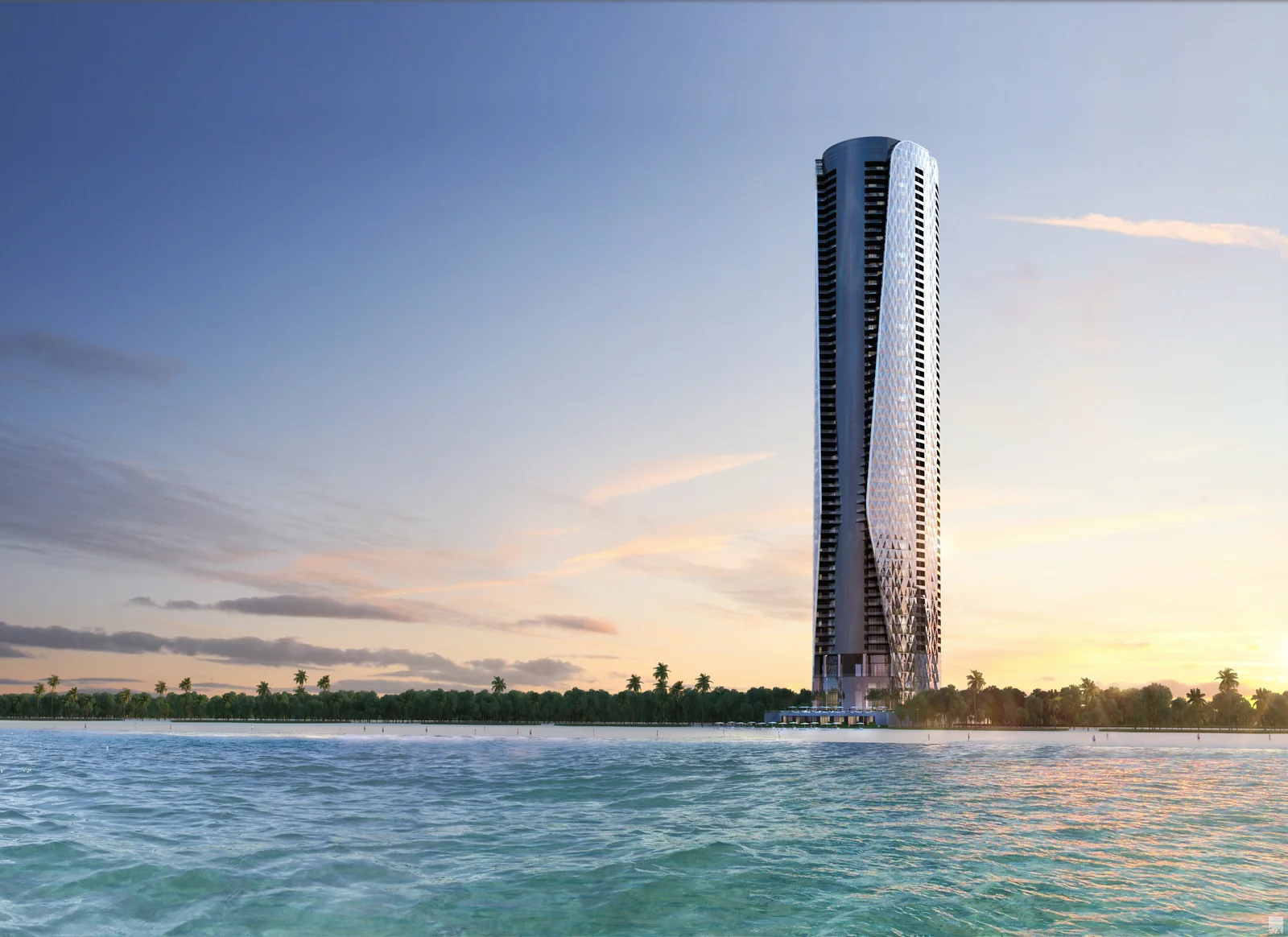
Most car companies that enter real estate license a name and a mood board. Bentley Motors did something more deliberate: it put its own design studio to work on a residential tower, the same way it would approach a new model line. Bentley Residences - rising on the sand in Sunny Isles Beach, Florida - is the result, and it is currently the only residential project Bentley Motors has designed anywhere in the world.
That distinction matters more than it sounds. Branded residences are a crowded category now, and most of them borrow a crest for the lobby signage and call it a day. Bentley’s approach is closer to the one Automobili Lamborghini took a continent away at Tierra Viva in Benahavís: treat the brand’s design language as raw material, not decoration, and ask whether a century of automotive craft can actually survive the translation into concrete, glass and marble. At Brightwill, we think that test is the only one worth applying to a design-led branded residence, and Bentley Residences is one of the more rigorous attempts we have seen it pass.
The Bentley design alphabet
Before a building can read as “Bentley,” it helps to know what makes a Bentley look like a Bentley. Founded in 1919 by W.O. Bentley in Cricklewood, London, and now headquartered in Crewe, England, the marque built its identity on six Le Mans victories in the 1920s and ’30s and a philosophy the company still uses as its internal shorthand: an “unreasonable attention to detail.” Three ideas do most of the work in translating that philosophy into a physical object.
The Matrix grille and the Flying B. Bentley’s front-end signature is a honeycomb-pattern grille flanked by twin headlamps, crowned by the winged “B” mascot that has topped every Bentley since the 1920s. It is the automotive equivalent of a coat of arms - instantly legible, deliberately old-fashioned, and never simplified away no matter how modern the car underneath becomes.
Diamond quilting. Step inside any modern Bentley and the first thing you touch is quilted leather, stitched in a diamond pattern that has become as much a Bentley signature as the wings on the bonnet. It signals handwork in an era of injection-molded interiors - a texture that says a person, not a machine, decided where every seam falls.
The power line. Bentley designers describe a single crease that runs the length of the car’s flank, from headlamp to taillight, giving even a stationary car a sense of forward motion. It is a quieter cousin of the “Gandini line” that defines Lamborghini’s silhouette - less aggressive, more restrained, but doing the same structural job.

From a car cabin to a 63-floor tower
The genuine design problem, as with any automotive-to-architecture translation, is that a car is meant to be experienced in motion and from the outside, while a home is still, private, and lived in slowly over years. Bentley Residences answers this by taking the diamond motif off the seat cushion and putting it on the building envelope: the tower’s curtain wall reads as a faceted, jewel-cut surface rather than a flat sheet of glass, so that the signature texture of a Bentley interior becomes the first thing you see from the beach, not the last thing you notice once you are inside.
Interiors carry the translation further. Bentley Home — the marque’s furnishing and interior-design arm — was brought in alongside the building’s architects, which means the residences are not “Bentley-inspired” in the way a hotel gift shop is inspired by its brand; the diamond stitching, the wood veneers, and the material logic of a Bentley cabin are specified the same way they would be for a car interior, carried through into cabinetry, lighting and finishes across 216 residences.
The car as the centerpiece
The single most theatrical piece of the concept, and the one that draws the most direct line to Tierra Viva’s Lamborghini showroom tower, is the building’s private sky garage. Selected residences include a robotic car lift - branded internally as the Dezervator - that carries an owner’s car up from the ground level directly into the home, where it parks behind glass in a dedicated garage room adjacent to the kitchen and living space. Individual residences accommodate three to four cars; combined units can house up to seven.
Where Tierra Viva frames its car lift as a glass display tower visible from the villa’s living room, Bentley Residences takes the same premise vertical: the car becomes part of the interior architecture of a high-rise home rather than a ground-level villa, which is a materially harder engineering problem and, arguably, a more literal expression of the idea that the car is not stored here - it is displayed. Two different brands, arriving at structurally similar conclusions about what a car-first buyer actually wants from a home: proximity, visibility, and none of the friction of a remote garage.

Sieger Suarez and the architecture of restraint
Bentley Motors did not design the tower alone. The architecture is by Sieger Suarez, the Miami firm founded by Charles Sieger and Jose Suarez that has shaped a large share of the city’s contemporary waterfront skyline. Their role in a project like this is less about imposing a separate architectural identity and more about executing Bentley’s design language at the scale and structural discipline a 63-floor oceanfront tower demands - a 710-foot form on a 2.4-acre site, holding 216 residences ranging from three to six bedrooms across 3,500 to 9,000 square feet, with delivery anticipated in 2027.
That division of labor - a single-focus automotive brand paired with a specialist high-rise architect, rather than one firm claiming to do both jobs - is one of the more reliable signals of a design-led branded residence built on genuine collaboration rather than a licensing arrangement dressed up as one.

Sunny Isles Beach: Miami’s branded-residence capital
Location does a quiet share of the work here. Sunny Isles Beach is the district our own Miami neighborhoods guide describes as the branded-residence capital of the oceanfront - home to Porsche Design Tower, the Ritz-Carlton, Armani/Casa, and now Bentley, all lined up along what the guide calls “Florida’s Riviera.” It is Miami’s most internationally owned district, drawing second-home and trophy buyers from Latin America and Europe for whom a recognized brand on the building carries as much weight as the ocean below the balcony.
For the wider context of how Sunny Isles Beach compares to Miami’s eighteen other luxury districts - from Fisher Island’s ferry-only privacy to Brickell’s urban branded-residence pipeline - see our complete Miami neighborhoods guide, or explore the full Brightwill portfolio across Miami.

Why automotive brands are building homes
Bentley is not acting alone. Lamborghini, Aston Martin, Porsche and Mercedes have all followed hospitality and fashion houses into residential real estate over the past decade, and the logic is consistent across brands: a residence extends a customer relationship that used to end at the dealership into something the owner lives inside every day. We cover the mechanics of that shift - what separates a genuinely design-led branded residence from a hotel-operated one, and why the category commands the premium it does - in our explainer on why branded residences are reshaping global luxury real estate.
Bentley and Lamborghini make an especially useful pair to compare, because they represent the two poles of automotive design philosophy applied to architecture: Bentley’s restrained, quilted, heritage-driven language against Lamborghini’s sharp, aerodynamic, wedge-driven one at Tierra Viva. Neither is a better translation in the abstract - they are simply different automotive personalities, tested against the same question of whether a brand’s design DNA can genuinely be built rather than merely referenced.
The Brightwill View
Strip away the car lift and the crest on the lobby wall, and the test we apply to any design-led branded residence is the same one we applied to Tierra Viva: does the brand’s actual design language - its materials, its proportions, its discipline - survive the translation, or does it stop at the signage? Bentley Residences passes that test on the strength of two decisions: bringing in Bentley Home to specify interiors with the same rigor as a car cabin, and engineering a sky garage that treats the car as visible architecture rather than something to be hidden below grade.
This is not simply a residential tower with a car brand attached to it. It is the physical argument that a century of automotive craft - the grille, the quilting, the unreasonable attention to detail - can be built at 63 floors instead of at four wheels.